When a third grader writes "203" and reads it as "twenty-three," the issue isn't carelessness. It's a gap in place value understanding, one of the most common and consequential sticking points in elementary math.
Place value is the idea that a digit's position determines its worth: the 3 in 300 is worth ten times as much as the 3 in 30. It sounds simple, but research shows that many kids move through upper elementary still relying on procedural rules ("just add a zero") instead of understanding why those rules work [1]. That gap shows up later when they hit decimals, fractions, and multi-digit multiplication.
The good news: hands-on games are one of the most effective ways to build genuine number sense around place value. This guide covers 10 games you can set up at home, organized by concept and grade-level focus.
What place value understanding looks like by grade
Kids revisit place value every year, but the expectations shift significantly between third and fifth grade.
Third grade: Understand that the digits in a three-digit number represent hundreds, tens, and ones. Compare numbers using less than, greater than, and equal to. Round whole numbers to the nearest 10 or 100.
Fourth grade: Extend understanding to numbers up to one million. Recognize that a digit in one place is ten times what it represents in the place to its right. Read and write multi-digit numbers in standard, word, and expanded form.
Fifth grade: Apply place value understanding to decimals through hundredths. Multiply and divide whole numbers by powers of 10, noticing how the decimal point shifts. Use place value reasoning to perform multi-digit operations.
If your kid is struggling with concepts above their grade level, the games below can help fill the gaps without the pressure of a worksheet.
Why manipulatives work better than worksheets at this stage
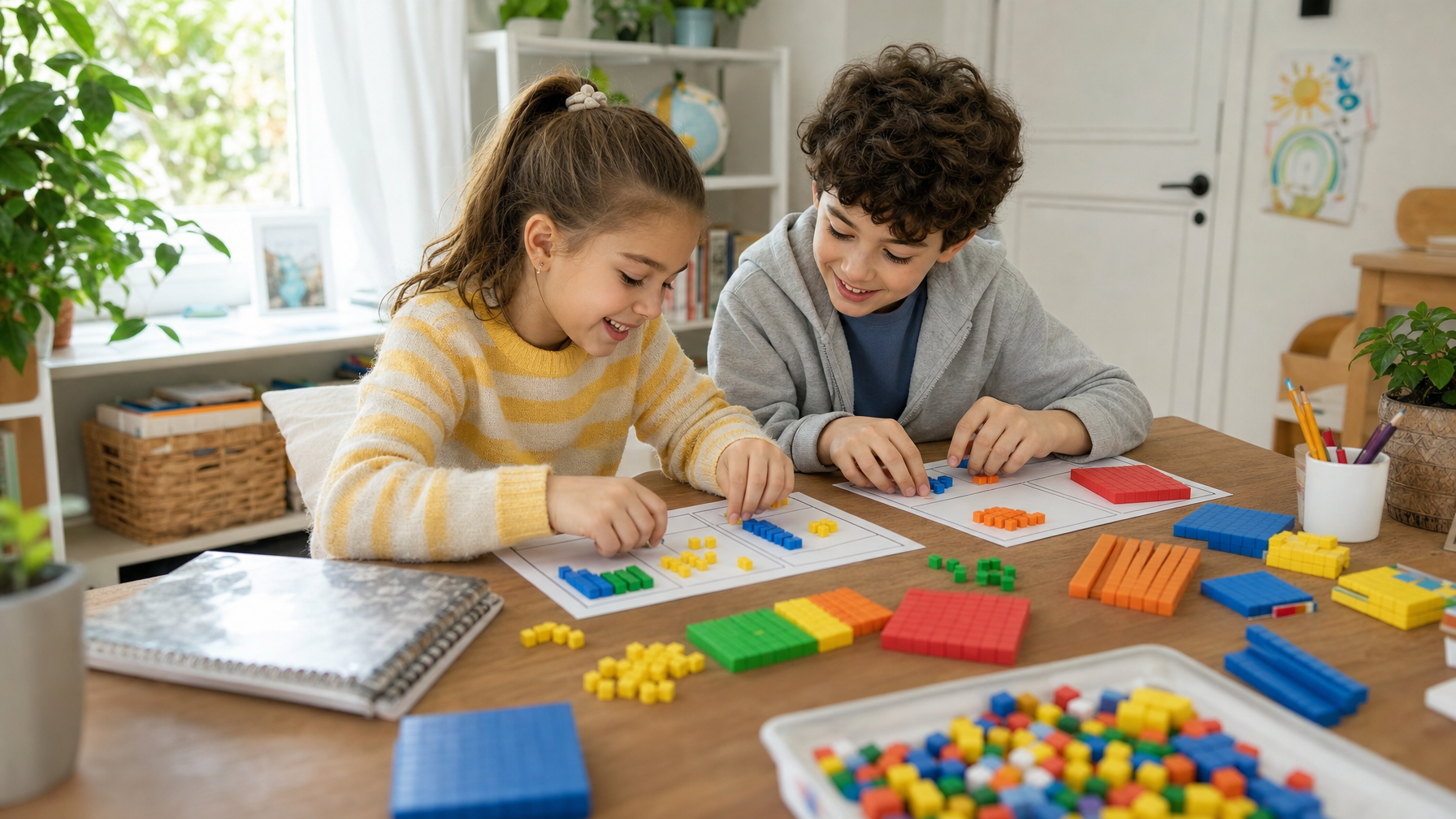
Research on math learning consistently shows that kids develop deeper understanding when they can physically represent numbers before moving to abstract notation [1]. Base-ten blocks, for example, let a kid see that 247 is literally two flats (hundreds), four rods (tens), and seven units. That sensory experience builds the mental model they'll rely on when the blocks are gone.
The progression researchers recommend is concrete (physical objects), representational (drawings and diagrams), and then abstract (numbers and symbols). Models and manipulatives aren't a crutch. They're the foundation that makes the abstract layer stick.
10 place value games to play at home
1. Place value war (third through fifth grade)
Each player draws three to five cards from a deck (remove face cards, use ace as 1). Arrange the cards to make the largest possible number. Compare. The bigger number wins the round. For a twist, challenge kids to make the smallest number or the number closest to a target like 5,000.
What it builds: Understanding how digit placement affects value. A kid who puts the 9 in the thousands place and the 2 in the ones place is demonstrating place value reasoning.
2. Base-ten block build race (third grade)
Give each player a pile of base-ten blocks (or printable cutouts). Roll two dice to create a two-digit number. Race to build that number using the correct combination of tens rods and ones cubes. First to build it correctly wins the round.
What it builds: Concrete understanding of how tens and ones compose a number.
3. Expanded form scavenger hunt (third through fourth grade)
Write numbers in expanded form on index cards (200 + 40 + 7) and hide them around the house. Kids find each card, convert it to standard form, and write it on their answer sheet. For fourth graders, include numbers in the thousands and ten-thousands.
What it builds: Fluency moving between expanded and standard form, reinforcing what each digit represents.
4. The decimal diner (fifth grade)
Create a pretend menu with items priced to the hundredths place ($3.47, $12.09, $0.85). Kids "order" a meal and calculate the total, practicing decimal addition and place value alignment. Bonus: have them calculate change from a $20 bill.
What it builds: Real-world application of decimal place value and the relationship between tenths, hundredths, and whole numbers.
5. Number line jump (third through fourth grade)
Draw a number line on a long piece of paper or use sidewalk chalk outside. Mark intervals of 10 (or 100 for bigger numbers). Call out a number and have your kid jump to where it belongs on the line. Ask: "Is 347 closer to 300 or 400? How do you know?"
What it builds: Number magnitude and rounding, both of which rely on place value understanding.
6. Mystery number (third through fifth grade)
Give clues based on place value: "My number has a 5 in the hundreds place, a digit in the tens place that is 3 more than the ones digit, and the ones digit is 2." Kids work backward to identify the number (552). Increase difficulty by adding thousands or decimal places.
What it builds: Ability to think about individual digit positions and their relationships to each other.
7. Roll and regroup (third grade)
Players start with zero. Each turn, roll a die and add that many ones cubes to your collection. When you reach 10 ones, trade them for a tens rod. First player to reach 100 (one hundreds flat) wins. Play in reverse for subtraction with regrouping.
What it builds: Concrete understanding of regrouping (carrying and borrowing), which is entirely a place value concept.
8. Place value puzzles with money (fourth through fifth grade)
Using real or play coins and bills, ask your kid to represent a number like 4.63 using dollars, dimes, and pennies. Then ask: "If I multiply this by 10, what happens?" Have them physically show the shift. The $4.63 becomes $46.30, and they can see the digits moving positions.
What it builds: The connection between multiplying by powers of 10 and how digit positions shift, a fifth grade standard that trips up many kids.
9. Digit swap challenge (fourth through fifth grade)
Write a number like 3,728 on a whiteboard. Ask: "What happens to the value if we swap the 7 and the 2?" Kids calculate both versions and find the difference. This game reveals whether they truly understand that the 7 is worth 700, not 7.
What it builds: Deep understanding that a digit's value depends entirely on its position.
10. Newspaper number hunt (third through fifth grade)
Give your kid a newspaper, magazine, or grocery flyer. Have them circle all the numbers they can find, then sort them into categories: numbers in the hundreds, thousands, and beyond. For each number, ask them to identify what the largest digit is worth. A kid who can look at "14,500 fans attended" and tell you the 1 is worth 10,000 has internalized place value.
What it builds: Recognizing and interpreting place value in real-world contexts.
Moving from concrete to abstract
Games are the starting point, not the finish line. Once your kid demonstrates consistent understanding with physical objects and hands-on activities, begin transitioning to representational tools (drawing base-ten models on paper) and then to abstract work (solving problems with just numbers). If they hit a wall at the abstract level, move back to the concrete. That's not regression. That's how mathematical reasoning develops.
If your kid needs additional support, an elementary math tutor can identify exactly where the gaps are and build targeted practice around them. And high-impact math games from experienced teachers can keep the momentum going between sessions.
Frequently asked questions
How do I know if my kid has a place value gap?
Ask them to read a number like 4,072 aloud. If they say "four thousand seventy-two," they're solid. If they say "four zero seven two" or get confused by the zero, there's a gap worth addressing. Another quick test: ask what the 7 in 3,704 is worth. If they say "7" instead of "700," they're reading digits, not values.
Are base-ten blocks necessary or can I use other objects?
Base-ten blocks are ideal because they're proportional (the tens rod is physically ten times the size of the ones cube), which reinforces the concept visually. But you can substitute: craft sticks bundled in tens, coins (pennies and dimes), or even LEGO bricks. The key is that the groupings of ten are visible and consistent.
My kid can do place value worksheets but struggles with word problems. Why?
Worksheets often test procedural skill (put the digits in the right columns) without requiring conceptual understanding. Word problems require kids to decide which operation to use and why, which demands deeper place value reasoning. More time with the games in this guide can help bridge that gap.
Sources
[1] Osana, H.P., Adrien, E., & Duponsel, N. (2023). Does Conceptual Transparency in Manipulatives Afford Place-Value Understanding? Education Sciences, 13(5), 518.


.svg)
.svg)